Thursday, April 19, 2012

To cut a bamboo

A short introduction for today's main topic.

A bamboo joint is a very strong shape. It gives flexibility and safety. The only real disadvantage is a bit of heaviness, but in most cases, when you make a bamboo joint in normal play, it gives you a powerful position, especially if you are in the middle, as it often happens.
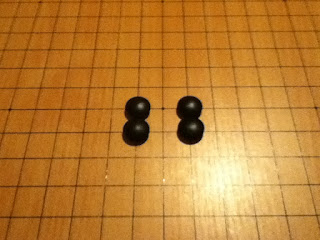


The obvious strength of the bamboo is that while still being wide, remains connected. The player that makes a bamboo shape can connect even if the opposing player plays on one of the spots inside the shape. It reaches out freely to all four sides (especially so to the left and right in the above image), so it is flexible as well.

That was the introductory part. Now the main event. :)

Today I came across a very interesting shape that is related to the bamboo, but a bit more complicated and infinitely more interesting.


The book in which I found it called it "the alien symbol". The main feature of the shape is the opposing stone in place of the last piece of the bamboo joint. The book gives an example of how this can be very good for the opposing side (white, in the above image).

There is a more general principle behind this shape. Here is a quote from the same book:

In many ways, the Alien Symbol is a structural representation of the creative conflict that is the hallmark of Go (and perhaps of life as well). Stones that are connected are strong, and stones that are cut are weak - as E.M. Forester says: "only connect". The bamboo joint and the tiger's mouth are the twin icons of connection. You can take out an opposing force of any size with almost nothing, if you aim for the connections and the incomplete links of the chain - spoiling the bamboo joint as in the case of the Alien Symbol, or playing on the pivot as in the case of the tiger's mouth.


Saturday, March 24, 2012

Life in the corner

Marta and myself have already lost over an hour on this.

http://eidogo.com/#2BPh5Jdd:0,0

The goal is simple: make life for black in the corner.

We have 1 way to do it so far. Leave yours in the comments.

Thursday, March 15, 2012

How to lose with a handicap

Hi everyone!

A few days ago, I had this game in which I was the handicapped player, and I managed to lose by resignation in ~80 moves. The opponent was way more skilled than me. However, it seems to me that all three big wins he had were solely due to my mistakes. Otherwise they were overplays. I hope not all handicap games turn out to be like that.

So, here goes:

2012-03-13-ioyuug-Median.sgf

The SGF is edited with my own experiments. You are welcome to introduce your own, and send them back if you wish, or, just tell me what you think in the comments. :)

So, the first big mistake I made was move 30, which allowed him to get a wall in the lower right. That could have been avoided by simply playing at N2, instead. Had i played there, his corner would have been way smaller than in the actual game.

Sunday, March 4, 2012

A few quotes

No game this time. Just a bit of wisdom.

I've just written a blog post about the album "Go" by Stomu Yamash'ta and some friends of his. I apologize in advance to the international reader for the other blog being in Serbian.

While researching material for the post, I've come across some go-related quotes I'd like to share. They are given here in no particular order.

"Begin anywhere." -John Cage

Thursday, February 23, 2012

A two-stone handicap against a 13k

Today I played a handicapped game, and thought it would be nice to share it. Aside from being the first handicapped game we will look at, it will also be the first game in which I lost that is analyzed on this blog. It is against a KGS player called daimazin. He was 13k? at the time of play.

I already mentioned ranks in go. These work mostly as a measure of skill relative to other players. This means that the kyu/dan system can be used to determine a handicap for the weaker player, with the aim of evening out the game. If a handicapped game is started with a properly determined number of stones, it is considered that if the weaker player wins (with the handicap) it is as rightful a victory as any other. (note: imho, this is a clear sign that we are part of a culture in which victory is achieved by doing one's best, rather than scoring a particular amount of points) Usually, one rank is worth one handicap stone. Since I was 11k? at the time of the game, daimazin had two handicap stones. Handicap stones are placed in a predetermined order on the board. For two handicap stones, it is the upper-right and lower-left star (hoshi) point. The handicapped player uses black stones, and white gets to play first, since if black played first, he would be three stones ahead. Usually handicapped games do not include the komi rule. Komi is believed to be worth one handicap, so it normally balances out for white the fact that black plays first.

Enough smalltalk, though. Here's the game.

2012-02-23-Median-daimazin.sgf

Now that I look back, I think that I have made a mistake already at move 7.  I should have entered the upper right corner as I planned. Since he is the handicapped player, he can afford to ignore the move I made at the left-side star point and deny me the corner in the upper right. Shouldn't have allowed that.

Tuesday, February 21, 2012

SmartGo 4s

Ok, first off - I'd like to announce that from now on, I'm going to be writing this blog in English. A very good friend pointed out that I can reach a much wider audience this way, and really, there is no real reason to limit this blog to a Serbian audience just because a large majority of my friends are Serbian. Indeed, probably any of my friends that would even find it worthwhile to read this blog already use English well enough to not be hindered by my (lack of experience in) use of English.

Anyway, let's look at a game.

Yesterday I played a game against SmartGo on my iPod touch. Right now, I'd like to take a moment and talk about the AI that I've encountered so far, and my experience with it. Probably the most popular go AI out there is GnuGo. You can find GnuGo in many PC go clients (such as GoPanda, for instance). This is because GnuGo is only an "engine" for playing go. The brain, basically. Obviously, there are many different GUI applications built around GnuGo, but the logic is always the same. GnuGo is a pretty powerful AI, as well. I have won against it only a few times so far, and that was with undoing some stupid mistakes I still tend to make in the heat of battle. If you can, I suggest playing against a weaker AI when you are only starting out. Bear in mind that GnuGo is an ideal partner for working on your battle technique. Here I mean small, local battles, and not the "war" that goes on throughout the entire board.

Thursday, February 16, 2012

Moja prva 15k partija

Dugo nisam igrao na KGS. Poslednji put kada sam igrao go, to je bilo protiv ortaka koji tek počinje da igra, i igrali smo na 13x13 tabli. Bila je lepa partija (zaista), ali nekako sam se tu više fokusirao na edukativni momenat, tj. da napravim situacije koje on može lepo da čita i da nauči što više. To je bilo pre 3 dana, a pre toga nisam igrao pune dve nedelje. Dve nedelje pre te partije sam prvi put bio u Klubu društvenih igara na Novom Beogradu, i odigrao jednu (za mene) veoma poučnu partiju sa igračem čijeg imena se ne sećam trenutno. Sramno sam izgubio, ali sam imao priliku da držim prave kamenčiće u rukama, i toliko mnogo sam naučio da mi poraz nije pao nimalo teško. Čak naprotiv.

Sa time u glavi sam se danas odlučio da pokušam da primenim stečeno znanje, i izgubim još koju partiju. Kada sam se ulogovao na KGS, on mi je dao (14k?) rang što me je malo zbunilo. Poslednji rang koji sam imao na KGS je bio 17k. Verovatno pretpostavlja da sam se poboljšao u međuvremenu, a ne obrnuto. To je interesantno. U svakom slučaju, upario me je sa likom koji je 15k, i očekivao sam da će me on definitivno dobiti, pošto nikada do sad nisam igrao protiv 15k. Mislim da jesam jednom, kad sam bio 17k, na samom početku online igranja, i to je bilo sa dva hendikepa. Bilo teško mlaćenje (mene). Valjda je to bio 15k.

Elem, ispostavi se da sam uspeo sa izvesnom lakoćom da pobedim. Tj. bila je velika razlika, a sama partija mi je oduzela puno snage i koncentracije. Imam utisak da taj protivnik nije trebalo da bude čak 15k. Pravio je neke baš nezgodne greške. Možda je isprobavao nešto. U svakom slučaju, evo partije: